



Quick Links
- The Dog-Sitting Moment That Changed How I Explain Marketing
- Why Marketing Feels So Overwhelming
- The Fight-Flight-Freeze Cycle of Marketing
- The 3-Step Marketing Check for Overwhelmed Entrepreneurs
- What Happens When You Follow the System
This weekend, my husband and I were dog-sitting. He admitted to me that he was completely overwhelmed because he couldn’t read the dog’s signals. “I can tell she wants something,” he said, “but I don’t know what.”
The more anxious he felt, the worse it got. His brain went into fight-flight-or-freeze mode. Meanwhile, I lost my patience because, in my head, it shouldn’t be that complicated. But watching him freeze made me realize something: when you don’t know what to look for, everything feels urgent and overwhelming.
Later, when we both calmed down, I explained something simple. Dogs have three basic needs: They need to eat. They need to poop. And they need to walk. And having a routine makes this easier.
If it’s not mealtime, take them out to poop. If they’ve done that and still seem restless, go for a walk. And if you’ve done all three, relax. You’ve done your part. The dog will settle.
This simple system demystified the process for him. Suddenly, he wasn’t guessing or reacting. He had a framework.
And that’s when it hit me: this is exactly how small business owners feel about marketing.
Why Marketing Feels So Overwhelming
“Marketing” sounds like one word. But in reality, it’s an umbrella for dozens of moving parts. It could mean posting on social media, writing a newsletter, updating your website, designing graphics, running ads, or even just talking to potential clients.
It also overlaps with branding. Your tone of voice, your messaging, and your visuals. And it often gets confused with sales. Then there’s strategy: deciding what to do, when to do it, and how to measure if it’s working.
Each of these pieces feels like its own full-time job. And when you’re wearing every hat in your business, the pressure is enormous. No wonder so many entrepreneurs freeze. No wonder every email, every notification, every slow day feels like an emergency. Without a simple system to guide your actions, you end up operating from a place of panic instead of a plan. And panic-driven marketing rarely works.
The Fight-Flight-Freeze Cycle of Marketing
Most early-stage entrepreneurs start their business without a financial cushion. They tell themselves, “This has to work, and it has to work fast.” That kind of pressure doesn’t just live in your head; it bleeds into everything you do. It shows up in your tone, your content, and your conversations with potential clients.
When panic takes over, most people default to one of three reactions:
- Fight: Pushing too hard. Posting constantly without a plan.
- Flight: Pivoting to the next “big idea” every time something doesn’t work instantly.
- Freeze: Doing nothing because you don’t know where to start.
And when the silence stretches on (no comments, no inquiries, no sales) you spiral even more. You start to believe the story that you’re failing.
But pause for a second and ask yourself: Where is this fear really coming from? What’s the worst thing that could happen if you slow down? Or if you pull back to regroup? If you take time to put a real system in place instead of throwing spaghetti at the wall?
If the truth is that you need to get your finances in order before you push full steam ahead, so be it. That’s not failure. That’s a learning lesson. In fact, FAIL is just an acronym: First Attempt In Learning.
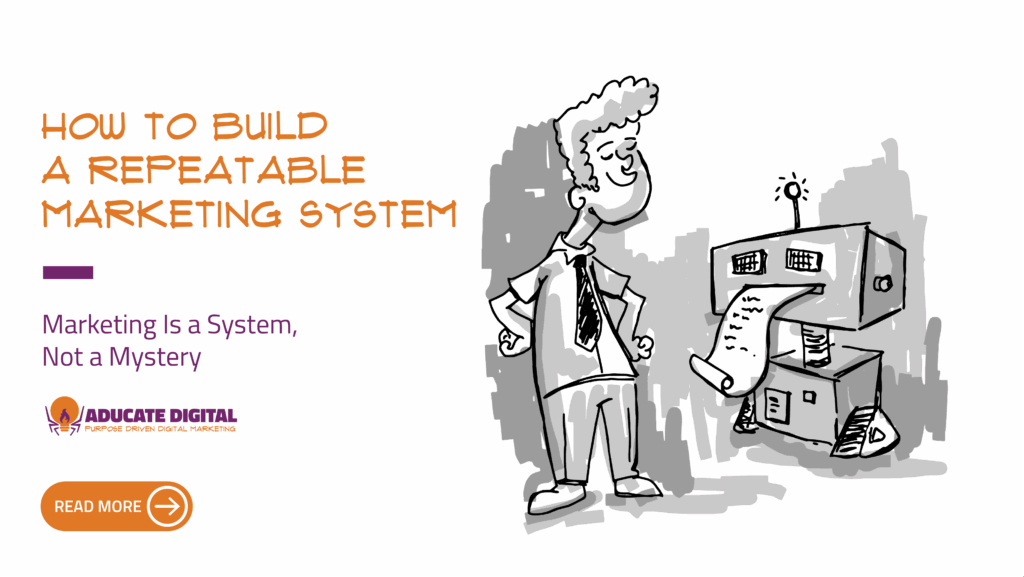
When you look at it that way, marketing stops being this high-stakes gamble and starts becoming what it really is, a process. A system. Something you can learn and repeat. Once you understand that system, you can stop reacting and start leading.
The 3-Step Marketing Check for Overwhelmed Entrepreneurs
Just like dogs have three base needs, your marketing does too. When you feel lost, check these three things before you panic:
Step 1: Feed It. Did You Put Something Out There?
Marketing only works if you give it something to work with. Ask yourself:
- Did I share something recently? (Example: a social post, an email, a conversation)
- Does it clearly say what I do and how I can help?
Examples:
- Post a photo of a recent project with one sentence: “This is how I help [type of client] solve [problem].”
- Send a short email: “I’ve got 2 spots open next month for [service]. Want details?”
Step 2: Walk It. Did You Share It in the Right Place?
Putting content out once isn’t enough. You need to move it.
- Did I share it where my audience actually is?
- Did I make it easy for people to respond?
Examples:
- If your clients are local, share your offer in a neighborhood Facebook group.
- If your audience is on LinkedIn, post there and comment on 3 other posts.
- If you sent an email, mention it in your Instagram Stories.
Step 3: Let It Rest. Am I Giving It Time Before Panicking?
The hardest part is waiting. Ask yourself:
- Have I given this enough time to work?
- Am I tracking signals before changing everything?
Examples:
- If you posted yesterday and no one commented, don’t delete it. Give it a few days.
- If you sent an email, wait a week before sending another.
- If you ran an ad, let it run for 2 weeks before you decide to change it.
What Happens When You Follow the System
When my husband followed the three steps for the dog, he felt calm. He knew what to do and he knew when to stop. And the dog settled. Your marketing works the same way. When you feed it, walk it, and let it rest, you stop spinning out. You trust the system. You give your efforts a chance to work.
Sometimes though, things can still flub up. Even when you’ve done all three steps and given it time, it still doesn’t seem to be working. That’s when you need to resist the urge to burn it all down and start over. The goal isn’t to scrap everything. It’s to change one variable at a time.
Think back to the dog analogy: if you’ve fed them, taken them outside, and walked them, but they’re still restless, maybe they need a longer walk. Then you let them rest again. The same applies to marketing. If Instagram posts aren’t moving the needle, try a different content format. Maybe short videos instead of static posts but keep everything else the same for a while. If your email open rates are low, tweak your subject line, not your entire email strategy.
This is how you stay in control. You know the system, you trust the process, and when something isn’t working, you make a small, intentional adjustment instead of reacting from panic. Success doesn’t come from guessing. It comes from paying attention to signals and making smart, measured moves.
Ready to Build Your Own Repeatable Marketing System?
If you’re tired of marketing feeling like a guessing game, start with this simple framework. And when you’re ready to go deeper, I’ll help you build a marketing system that feels clear, consistent, and repeatable. That way you can stop reacting and start leading.